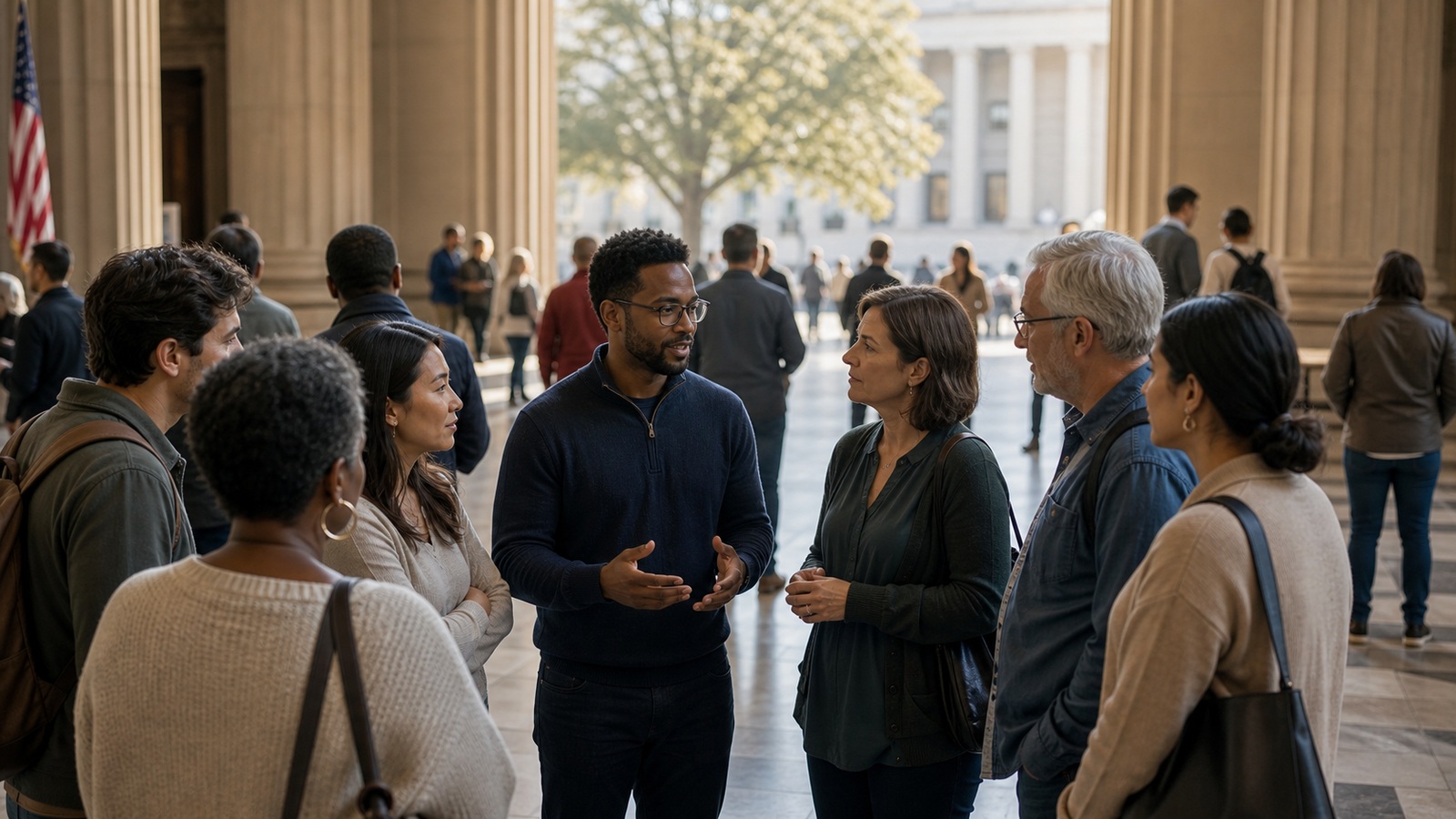
Some constitutional language works quietly, influencing public life long after the ink has dried. The words We the People appear in the Preamble, a brief opening that tells readers what the constitutional system is meant to pursue. The opening words place political authority in the public rather than in a monarch, a legislature, or a collection of states acting alone. For an article focused on constitutional function, the key is to resist treating the phrase as decoration. It is a civic guidepost: a compact statement that helps connect founding-era problems, constitutional structure, and modern public life. The phrase has always carried a difficult question: who counted as part of the political people at a given moment, and how did excluded groups press the nation toward a broader answer? Understanding that balance makes the Preamble easier to read and far more useful when public debates become complicated.
A: At the Philadelphia Convention, the wording changed as delegates moved from a loose confederation toward a national constitutional framework. The connection is clearest when the phrase is read alongside the rest of the Constitution. Use this as a starting point for reading the text closely.
A: The phrase has always carried a difficult question: who counted as part of the political people at a given moment, and how did excluded groups press the nation toward a broader answer? The connection is clearest when the phrase is read alongside the rest of the Constitution. This helps separate constitutional purpose from a stand-alone legal rule.
A: Voting, petitioning, jury service, public debate, and peaceful civic organizing are practical ways citizens continue to give the phrase meaning. The connection is clearest when the phrase is read alongside the rest of the Constitution. It also shows why historical context matters.
A: The expansion of citizenship and voting rights after the Civil War, during the women's suffrage movement, and through later civil-rights reforms changed the lived meaning of the opening words. The connection is clearest when the phrase is read alongside the rest of the Constitution. The point becomes clearer when connected to public institutions.
A: The opening words place political authority in the public rather than in a monarch, a legislature, or a collection of states acting alone. The connection is clearest when the phrase is read alongside the rest of the Constitution. This is a useful guardrail against oversimplification.
A: At the Philadelphia Convention, the wording changed as delegates moved from a loose confederation toward a national constitutional framework. The connection is clearest when the phrase is read alongside the rest of the Constitution. It gives non-experts a concrete way into the discussion.
A: The phrase has always carried a difficult question: who counted as part of the political people at a given moment, and how did excluded groups press the nation toward a broader answer? The connection is clearest when the phrase is read alongside the rest of the Constitution. The distinction matters when modern disputes become polarized.
A: Voting, petitioning, jury service, public debate, and peaceful civic organizing are practical ways citizens continue to give the phrase meaning. The connection is clearest when the phrase is read alongside the rest of the Constitution. It is worth comparing with the Constitution's operative articles.
A: The expansion of citizenship and voting rights after the Civil War, during the women's suffrage movement, and through later civil-rights reforms changed the lived meaning of the opening words. The connection is clearest when the phrase is read alongside the rest of the Constitution. Citizens can use this lens when evaluating public claims.
A: The opening words place political authority in the public rather than in a monarch, a legislature, or a collection of states acting alone. The connection is clearest when the phrase is read alongside the rest of the Constitution. The larger lesson is that constitutional purposes work together.
The Preamble’s Job in the Constitutional Design: We the People
The historical background adds an important layer. The phrase has always carried a difficult question: who counted as part of the political people at a given moment, and how did excluded groups press the nation toward a broader answer? Voting, petitioning, jury service, public debate, and peaceful civic organizing are practical ways citizens continue to give the phrase meaning. The point is not that the Preamble supplies a stand-alone legal answer to every dispute. Its value is orienting: it helps explain why the Constitution creates powers, divides them, and subjects their use to public accountability. For this article’s constitutional function lens, that connection deserves particular attention, especially the founding-era problem.
The relevant questions are concrete. Who has authority? What limits apply? Which rights must be protected? What process is due? How can officials act effectively without treating constitutional restraint as an inconvenience? At the Philadelphia Convention, the wording changed as delegates moved from a loose confederation toward a national constitutional framework. The expansion of citizenship and voting rights after the Civil War, during the women’s suffrage movement, and through later civil-rights reforms changed the lived meaning of the opening words. There is also a useful discipline here. The phrase should not be treated as a blank check for whichever policy someone favors. It belongs inside the larger Constitution, alongside enumerated powers, individual rights, federalism, and checks and balances. Seen through constitutional function, the issue becomes easier to recognize without losing its constitutional complexity; this section highlights the limits of simple slogans.
From Aspiration to Governing Structure: We the People and constitutional function
The constitutional structure turns the phrase into more than a slogan. The expansion of citizenship and voting rights after the Civil War, during the women’s suffrage movement, and through later civil-rights reforms changed the lived meaning of the opening words. The opening words place political authority in the public rather than in a monarch, a legislature, or a collection of states acting alone. This perspective keeps the discussion accessible without flattening the complexity. A constitutional principle becomes meaningful when people can connect its historical origin to a current decision, a public institution, or a right exercised in daily life. For this article’s constitutional function lens, that connection deserves particular attention, especially institutional design.
A careful reader should also notice the time dimension. The same language has been invoked across different eras, but each generation encounters new facts, technologies, institutions, and public expectations. The opening words place political authority in the public rather than in a monarch, a legislature, or a collection of states acting alone. Voting, petitioning, jury service, public debate, and peaceful civic organizing are practical ways citizens continue to give the phrase meaning. Reading the words in context avoids two extremes: dismissing them as decoration or treating them as an unlimited grant of authority. The better approach is to see them as a statement of purpose that guides civic judgment. Seen through constitutional function, the issue becomes easier to recognize without losing its constitutional complexity; this section highlights the connection to public institutions.
The Limits Hidden Inside the Goal: We the People and constitutional function
A useful way to test the idea is to move from theory to ordinary public life. Voting, petitioning, jury service, public debate, and peaceful civic organizing are practical ways citizens continue to give the phrase meaning. The phrase has always carried a difficult question: who counted as part of the political people at a given moment, and how did excluded groups press the nation toward a broader answer? There is also a useful discipline here. The phrase should not be treated as a blank check for whichever policy someone favors. It belongs inside the larger Constitution, alongside enumerated powers, individual rights, federalism, and checks and balances. For this article’s constitutional function lens, that connection deserves particular attention, especially the boundary between purpose and power.
The Preamble invites a long view. It asks citizens to evaluate not only whether government acts, but how it acts, whose voice is heard, and whether the result strengthens a durable constitutional order. The opening words place political authority in the public rather than in a monarch, a legislature, or a collection of states acting alone. At the Philadelphia Convention, the wording changed as delegates moved from a loose confederation toward a national constitutional framework. That is why the subject remains worth studying. It offers a vocabulary for disagreement that is constitutional rather than purely partisan, and it reminds citizens that argument can coexist with a shared framework. Seen through constitutional function, the issue becomes easier to recognize without losing its constitutional complexity; this section highlights the problem of excluded voices.
When National Power Enters the Conversation: We the People and constitutional function
The principle also contains a warning against easy answers. At the Philadelphia Convention, the wording changed as delegates moved from a loose confederation toward a national constitutional framework. The expansion of citizenship and voting rights after the Civil War, during the women’s suffrage movement, and through later civil-rights reforms changed the lived meaning of the opening words. Reading the words in context avoids two extremes: dismissing them as decoration or treating them as an unlimited grant of authority. The better approach is to see them as a statement of purpose that guides civic judgment. For this article’s constitutional function lens, that connection deserves particular attention, especially a practical civic example.
It also encourages civic humility. No single election, court case, or law permanently settles the full meaning of a broad constitutional purpose. Democratic maintenance is continuous work. The phrase has always carried a difficult question: who counted as part of the political people at a given moment, and how did excluded groups press the nation toward a broader answer? Voting, petitioning, jury service, public debate, and peaceful civic organizing are practical ways citizens continue to give the phrase meaning. That history matters because popular sovereignty is not merely ceremonial language. It gives readers a way to ask whether institutions are serving constitutional purposes while remaining within constitutional limits. Seen through constitutional function, the issue becomes easier to recognize without losing its constitutional complexity; this section highlights the discipline of reading in context.
The State and Local View: We the People and constitutional function
Modern debates show why the language has endured. The opening words place political authority in the public rather than in a monarch, a legislature, or a collection of states acting alone. Voting, petitioning, jury service, public debate, and peaceful civic organizing are practical ways citizens continue to give the phrase meaning. That is why the subject remains worth studying. It offers a vocabulary for disagreement that is constitutional rather than purely partisan, and it reminds citizens that argument can coexist with a shared framework. For this article’s constitutional function lens, that connection deserves particular attention, especially the relationship between rights and order.
For non-experts, this is encouraging rather than intimidating. The first step is not mastering every case citation. It is learning to recognize the constitutional questions inside familiar events. The expansion of citizenship and voting rights after the Civil War, during the women’s suffrage movement, and through later civil-rights reforms changed the lived meaning of the opening words. The opening words place political authority in the public rather than in a monarch, a legislature, or a collection of states acting alone. The point is not that the Preamble supplies a stand-alone legal answer to every dispute. Its value is orienting: it helps explain why the Constitution creates powers, divides them, and subjects their use to public accountability. Seen through constitutional function, the issue becomes easier to recognize without losing its constitutional complexity; this section highlights the difference between ceremony and substance.
A Civic Test for the Present Day: We the People and constitutional function
For citizens, the most practical lesson is participation joined with attention. The opening words place political authority in the public rather than in a monarch, a legislature, or a collection of states acting alone. At the Philadelphia Convention, the wording changed as delegates moved from a loose confederation toward a national constitutional framework. That history matters because popular sovereignty is not merely ceremonial language. It gives readers a way to ask whether institutions are serving constitutional purposes while remaining within constitutional limits. For this article’s constitutional function lens, that connection deserves particular attention, especially the role of public accountability.
Consider how the issue appears outside a textbook. A city meeting, a federal court case, an election, a public-safety decision, or a dispute between state and national officials can all reveal the choices built into constitutional government. Voting, petitioning, jury service, public debate, and peaceful civic organizing are practical ways citizens continue to give the phrase meaning. The phrase has always carried a difficult question: who counted as part of the political people at a given moment, and how did excluded groups press the nation toward a broader answer? This perspective keeps the discussion accessible without flattening the complexity. A constitutional principle becomes meaningful when people can connect its historical origin to a current decision, a public institution, or a right exercised in daily life. Seen through constitutional function, the issue becomes easier to recognize without losing its constitutional complexity; this section highlights the practical meaning of self-government.
Reading the Constitution With Purpose: We the People
We the People remains important because the Constitution is both a governing document and a public inheritance. Voting, petitioning, jury service, public debate, and peaceful civic organizing are practical ways citizens continue to give the phrase meaning. From the standpoint of constitutional function, the Preamble does not remove disagreement, and it was never designed to do so. Instead, it places disagreement inside a constitutional project with purposes, boundaries, and responsibilities. When citizens learn the history, examine the limits, and connect the words to present-day institutions, the opening lines become more than a familiar recital. They become a practical invitation to participate thoughtfully in the work of self-government.
Further Perspective 1: We the People Through constitutional function
The principle also contains a warning against easy answers. The opening words place political authority in the public rather than in a monarch, a legislature, or a collection of states acting alone. Voting, petitioning, jury service, public debate, and peaceful civic organizing are practical ways citizens continue to give the phrase meaning. That is why the subject remains worth studying. It offers a vocabulary for disagreement that is constitutional rather than purely partisan, and it reminds citizens that argument can coexist with a shared framework. For this article’s constitutional function lens, that connection deserves particular attention, especially the interaction of state and national authority.
For non-experts, this is encouraging rather than intimidating. The first step is not mastering every case citation. It is learning to recognize the constitutional questions inside familiar events. The expansion of citizenship and voting rights after the Civil War, during the women’s suffrage movement, and through later civil-rights reforms changed the lived meaning of the opening words. The opening words place political authority in the public rather than in a monarch, a legislature, or a collection of states acting alone. The point is not that the Preamble supplies a stand-alone legal answer to every dispute. Its value is orienting: it helps explain why the Constitution creates powers, divides them, and subjects their use to public accountability. Seen through constitutional function, the issue becomes easier to recognize without losing its constitutional complexity; this section highlights the balance between energy and restraint.