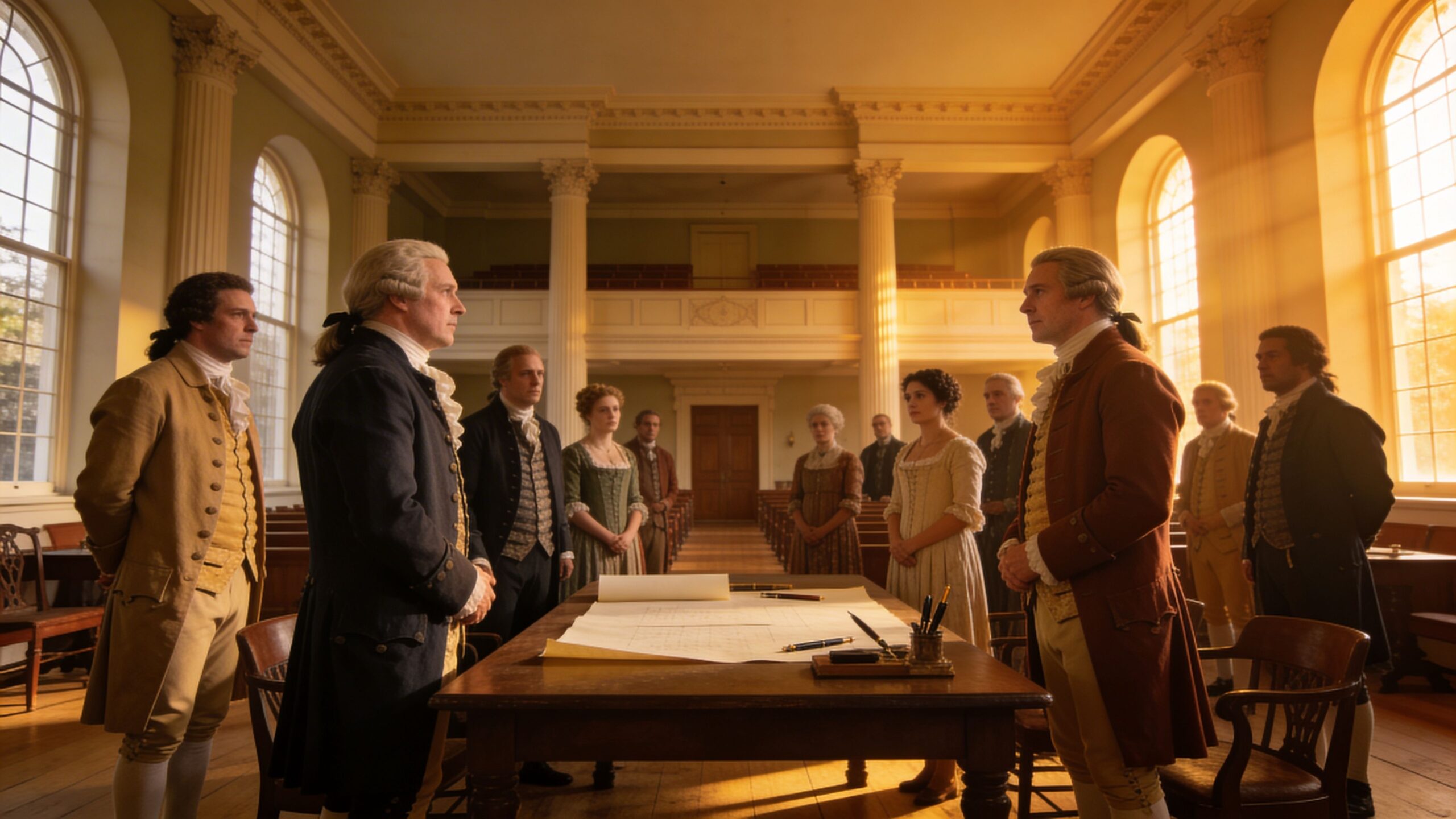
When the Second Continental Congress adopted the Declaration of Independence in July 1776, it announced more than a political break from Great Britain. It articulated a philosophy of government that had been developing for decades in the minds of colonial thinkers. At the center of that intellectual transformation stood John Locke, a seventeenth-century English philosopher whose ideas about natural rights, consent, and limited government profoundly shaped the American founding.
A: Not exactly—Jefferson adapted Lockean ideas into a new American political argument.
A: It broadened the idea beyond material property while keeping the core rights-first logic.
A: The framework: natural rights, government by consent, and the right to replace tyranny.
A: No—he argues people tolerate many wrongs; revolt is justified after persistent abuses.
A: Government exists to protect rights; when it attacks them, it breaks its foundational purpose.
A: Through representation, elections, and laws made with public authorization rather than force.
A: No—English constitutional tradition, colonial experience, and other Enlightenment thinkers also mattered.
A: Using power outside the law for private ends instead of the public good.
A: To meet Locke’s “pattern of abuse” logic and persuade a broad audience of the necessity.
A: Rights require institutions, accountability, and citizens who insist that power stays tied to consent.
Natural Rights and the Foundation of Human Equality
One of Locke’s most enduring contributions to political thought was his theory of natural rights. In his work Two Treatises of Government, Locke argued that all individuals are born in a state of natural freedom and equality. They possess inherent rights to life, liberty, and property. These rights do not originate from kings, governments, or social status. They are rooted in human nature itself.
This concept became the moral foundation of the Declaration of Independence. Jefferson famously wrote that all men are created equal and are endowed with certain unalienable rights. Though the wording differs slightly from Locke’s formulation, the philosophical structure is unmistakable. The Declaration’s assertion that rights are unalienable reflects Locke’s belief that they cannot be legitimately surrendered or taken away.
Locke’s emphasis on equality also challenged hierarchical political systems. In rejecting divine right monarchy, he argued that no individual is born with a natural claim to rule others. This radical idea resonated strongly in the American colonies, where resentment toward hereditary privilege and distant authority was already growing.
By grounding the Declaration in natural rights, Jefferson and the other Founders elevated the American cause from a local dispute to a universal principle. The Revolution was framed not as a rebellion for convenience, but as a defense of fundamental human rights.
Consent of the Governed and Legitimate Authority
Locke’s political theory did not stop at identifying natural rights. He also asked a crucial question: where does legitimate political authority come from? His answer was revolutionary for its time. Government derives its power from the consent of the governed.
In Locke’s view, individuals leave the state of nature and form political societies through a social contract. They agree to establish a government for the purpose of protecting their rights. This consent, whether expressed directly or through representation, is the only legitimate basis for political power.
The Declaration of Independence reflects this principle with clarity. It states that governments are instituted among men, deriving their just powers from the consent of the governed. This line echoes Locke almost word for word. Authority is not divine. It is not inherited. It is granted by the people.
For American colonists, this idea provided a powerful justification for independence. If Parliament and the Crown exercised authority without genuine colonial consent, then their rule lacked legitimacy. The Declaration’s argument rests on this Lockean premise. Britain had violated the social contract by imposing laws and taxes without proper representation.
By invoking consent of the governed, the Declaration established a new standard for political legitimacy. It asserted that authority must be accountable to the people, a principle that became central to American constitutional design.
The Right of Revolution and Breaking the Bonds
Perhaps the most dramatic element of Locke’s influence appears in the Declaration’s defense of revolution. Locke argued that when a government persistently violates the rights it was created to protect, the people have not only the right but the duty to resist and replace it.
This idea was bold and dangerous. It directly challenged the long-standing belief that rebellion against a monarch was sinful or unlawful. Locke reframed resistance as a legitimate response to tyranny. If rulers breach the social contract, they forfeit their authority.
The Declaration of Independence adopts this reasoning with remarkable confidence. After asserting natural rights and consent, it states that whenever any form of government becomes destructive of these ends, it is the right of the people to alter or abolish it. This is pure Lockean logic.
The lengthy list of grievances against King George III serves as evidence that Britain had violated its obligations. By documenting abuses, Jefferson built a case that the Crown had broken the social contract. Independence was therefore not rash rebellion but a justified act of political self-defense.
Locke’s theory of the right of revolution gave the American cause philosophical legitimacy. It transformed a colonial uprising into a principled defense of liberty grounded in reason and justice.
Limited Government and the Protection of Rights
Locke believed that government should be limited in scope and purpose. Its primary function is to secure natural rights. It does not exist to dominate, enrich rulers, or micromanage every aspect of life. Political power must be restrained to prevent abuse.
The Declaration reflects this understanding by clearly defining government’s purpose. It exists to secure rights. When it fails to do so, it loses legitimacy. This concise statement encapsulates Locke’s vision of limited government.
The American Revolution was therefore not simply about replacing one ruler with another. It was about redefining the role of government itself. By adopting Lockean principles, the Founders set the stage for a constitutional system built on checks, balances, and enumerated powers.
Although the Declaration does not outline specific institutional arrangements, its philosophical framework directly influenced the later drafting of the Constitution. The idea that power must be constrained and directed toward protecting liberty became a guiding principle of American governance.
Locke’s suspicion of concentrated authority helped shape a political culture wary of centralized control. This legacy can be seen in debates over federalism, separation of powers, and individual rights that continue to define American politics.
Property, Pursuit of Happiness, and Moral Evolution
One of the most discussed differences between Locke and Jefferson lies in the substitution of “pursuit of happiness” for “property.” Locke identified property as a central natural right, arguing that individuals have a right to the fruits of their labor. Property ownership provided security and independence, reinforcing personal liberty.
Jefferson’s choice to broaden this concept reflects both continuity and adaptation. The pursuit of happiness encompasses property while also extending beyond it. It suggests a broader vision of human flourishing, aligning with Enlightenment ideals about self-improvement, virtue, and personal fulfillment.
This modification demonstrates how Locke’s ideas were not copied mechanically but thoughtfully adapted to American circumstances. The Founders drew from Enlightenment philosophy while shaping it to fit their aspirations for a new society.
The emphasis on happiness also underscored the moral dimension of political life. Government exists not merely to maintain order but to create conditions in which individuals can pursue meaningful and fulfilling lives. This expansive vision of liberty remains a defining feature of American political thought.
Enlightenment Reason and the Language of Universal Principles
Locke’s influence on the Declaration is evident not only in specific concepts but also in its tone and structure. The document reads like a reasoned argument, carefully building from general principles to specific conclusions. This method reflects Enlightenment confidence in rational discourse.
The Declaration begins with universal claims about human equality and rights. It then explains the purpose of government and the conditions under which it may be dissolved. Only after establishing this philosophical foundation does it present a list of grievances.
This logical progression mirrors Locke’s analytical approach. It invites readers to evaluate the argument based on reason rather than emotion or tradition. The Founders sought to persuade both domestic and international audiences that their cause was just and grounded in universal principles.
By framing independence within Enlightenment philosophy, the Declaration transcended its historical moment. It spoke not only to Americans in 1776 but to future generations seeking liberty and self-government.
Enduring Echoes of Locke in American Democracy
John Locke’s influence on the Declaration of Independence extends far beyond the eighteenth century. His ideas about natural rights, consent, limited government, and the right of revolution continue to shape American political discourse. Debates about constitutional interpretation, civil liberties, and governmental authority often return to Lockean principles. The belief that rights precede government remains central to American identity. The insistence that authority must be grounded in consent underpins democratic elections and civic participation. Even the global impact of the Declaration reflects Locke’s legacy. Movements for independence and human rights around the world have drawn inspiration from its language and principles. In this sense, Locke’s philosophy helped ignite not only an American revolution but a broader transformation in political thought. The Founding Fathers did not simply borrow Locke’s ideas. They translated them into action. They transformed philosophical arguments into a declaration that altered the course of history. By grounding their case in natural rights and rational principles, they created a document that continues to resonate across centuries. John Locke’s influence on the Declaration of Independence demonstrates the power of ideas to shape nations. A philosopher’s pen helped guide a revolution, and his principles became embedded in the foundations of American democracy. The Declaration stands as both a political manifesto and a testament to Enlightenment thought, proving that enduring change begins with a bold reimagining of liberty, authority, and human dignity.